

FILE #4 — THE MIND FORGE

Welcome! If you’re new here, please visit the Table of Contents to catch up on any File releases you may have missed.
(Archived 2018-11-22 / Declassified 2029-03-25)
Location: Mirror Valley Institute, Sichuan
Author: Li Haojie (Observer K)
Archive Tag: MV-T-01
Entry 1 — Arrival
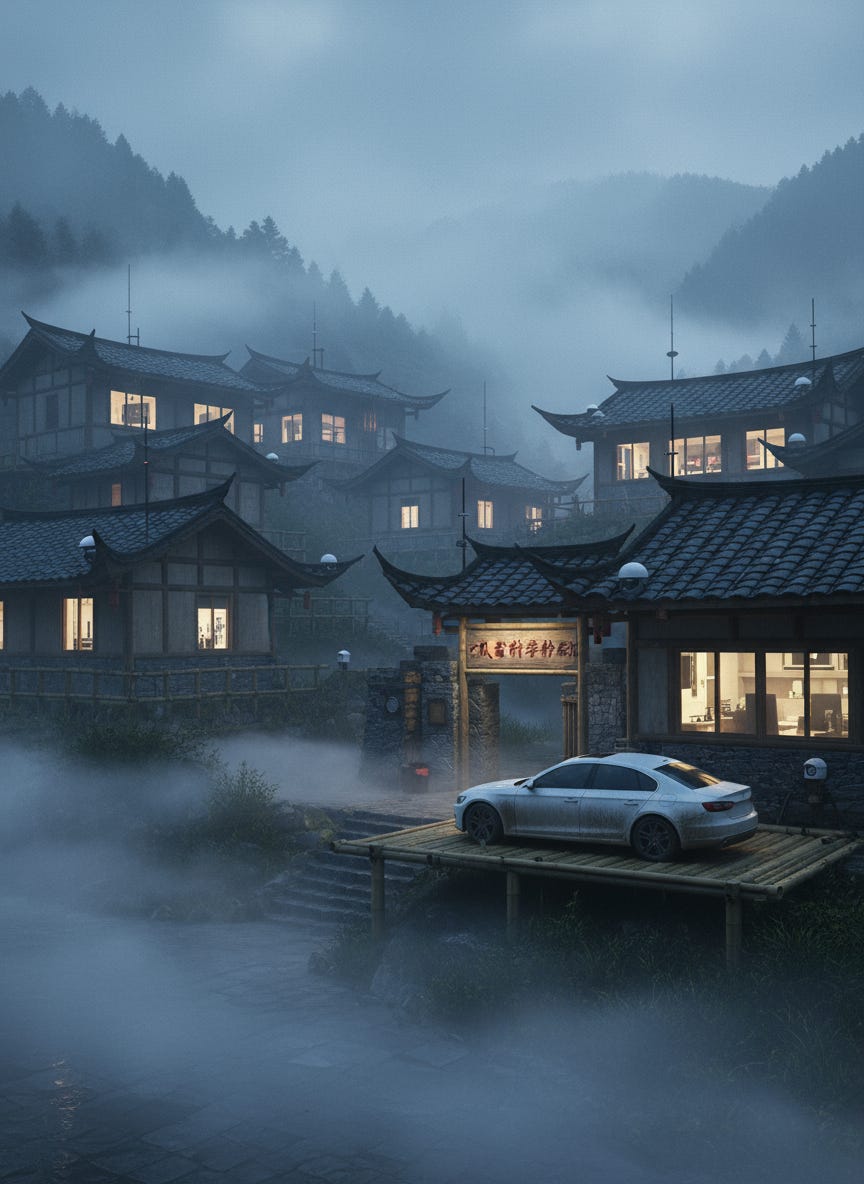
The train left me at Baoguo Station, beneath Mount Emei’s shadow. Mist hung low over terraces of bamboo; monks in gray robes mixed with soldiers in plain clothes. A white Toyota sedan waited by the platform, its license plate half-obscured by mud.
We drove through a tunnel that did not exist on any map. At its end stood a compound: slate roofs, prayer wheels that never turned, and antenna arrays disguised as weather vanes. A plaque at the gate read Sichuan Cognitive Sciences Annex.
The locals called it Mirror Valley.
A composed middle-aged woman in a white coat clipped a sensor to my finger. Later we called her Madam Guan. Her voice was calm, precise—yet carried a softness that unsettled the room. “Baseline reading,” she said. The machine traced my pulse — quick, uneven. I reached for my inhaler. She noted the motion on her clipboard.
“You’ll learn to breathe without help,” she said. I smiled weakly. “I doubt that.” She wasn’t wrong about the lesson, only its outcome.
Entry 2 — The First Tests
Our days began before dawn. Breakfast was a cup of barley water and a tablet of compressed glucose. Oxygen levels in the dorms were lowered each night by two percent.
The first lesson was called Clarity Under Deprivation. We performed complex differential equations while the air thinned. When others gasped, I slowed my breathing and counted between heartbeats.
My asthma, once weakness, became rhythm.
The instructor, a former PLA neurologist, watched my graphs flatten. “You are adapting quickly,” he said. “No,” I answered. “I’m remembering.” He didn’t know Stanford’s dry air had already trained me to think without comfort.
Entry 3 — Information Aikido
Interrogation was treated as art. We sat across from examiners who asked questions designed to provoke guilt, patriotism, fear.
Each heartbeat was mapped; each pupil dilation logged.
“Truth and falsehood,” said the manual, “are both forms of narrative compression.” We were told to redirect rather than resist.
By the third week I learned to answer without answering, to make the examiner chase his own syntax until he forgot the question.
Then came the polygraph chamber.
Electrodes on chest, fingers, temples. “Speak only lies,” said the operator. I recited the multiplication table backward and thought of Go patterns. The needle barely twitched.
Later they connected us to EEG caps for Neural-Imaging Neutralization. Most recruits trembled when red spikes of guilt flared across the monitor. I focused on the steady hiss of my inhaler — a mechanical breath — until the wave collapsed to silence. The operator stared at the flat line.
“He’s ghosting the signal,” someone whispered.
By the fifth month, they used me to calibrate the machines.
Entry 4 — The Dialectical Drill
The most demanding exercises were not physical but ideological. We were placed in simulated Oxford Union or Council on Foreign Relations meetings.
Our texts were not only historical archives but contemporary transcripts. We studied the forums where the West’s strategic conscience was forged: the Aspen Security Roundtable, the Munich Security Conference.
One day, I was assigned to defend Jeffrey Sachs’s framework for multilateral development against a peer role-playing a cynical CIA analyst. I had to marshal Sachs’s data, emulate his moral conviction, and make the case for global cooperation so convincingly that my “opponent” would be rhetorically disarmed. I had to believe it, temporarily, to make it persuasive.
Another day, I had to argue the hawkish position from a Heritage Foundation brief, citing Allison’s Thucydides Trap as an inevitable law of history. I felt the seductive simplicity of that narrative—the clarity that comes from accepting conflict as destiny.
Afterward, Madam Guan reviewed our biometrics. Her voice was measured, almost musical; her poise carried an ease that drew attention even in a room of soldiers. She studied the glowing graphs on her tablet.
“Your heart rate dropped when you argued for Sachs,” she said.
“Why?”
“Because it was the harder argument to make with sincerity,” I replied. “It required more control.”
She made a note, her expression unreadable. The faint scent of cedar from her coat lingered after she left. I didn’t tell her it was because part of me still wished that world was real.
Entry 5 — Blindfold Go Revisited
When they discovered my Go record from Stanford, they arranged a demonstration. Six boards. Six opponents. All simultaneous. Blindfolded.
For them it was legend in the making. For me, déjà vu. Stanford had been play; Mirror Valley demanded precision under duress.
A metronome ticked every fifteen seconds. Assistants called coordinates; I replied without pause. At the 128-minute mark, one instructor coughed—the pre-arranged signal for oxygen drop.
Others faltered; my mind stayed bright and crystalline.
When it ended: five resignations, one stalemate.
The director, Colonel Ma Yingde (馬英德), wrote a single line in my record: “Candidate L-7 demonstrates total-board cognition under hypoxia.”
Rumor said the Scholar requested the transcript.
Entry 6 — History Immersion
Our nights belonged to the past. We memorized the rise and fall of empires—Qin unity, Roman entropy, British overreach, American hubris.
Each pattern was dissected like a waveform: growth, excess, decay.
Professor Wang returned for a closed seminar. The guards called him the Scholar. He asked no questions about drills. Instead, he spoke of Deng’s long game—of 韜光養晦, hide brightness, nurture obscurity.
“Strength,” he said, “is the patience to appear weak until the field is calculable.”
He played a recording. A voice, crisp and American, filled the room:
“The liberal international order is not a historical inevitability; it is a choice that must be relentlessly renewed.”
“This is Dr. Joseph Nye,” he said. “You will not just understand ‘soft power.’ You will simulate his reasoning—anticipate the conditions under which he would advocate for its use or abandonment.”
Then another clip, heavier, more fatalistic:
“Great powers are always competing for power. That is the tragic truth of international politics.”
“John Mearsheimer,” the Scholar added. “His is the grammar of inevitability. Learn it until you dream in its syntax.”
When the lights rose, he found me still taking notes.
“You write as if the exam will be moral,” he said.
“Isn’t it?” I asked. “If strategy decides who suffers, then ethics must be part of the calculation.”
He looked almost amused.
“Ethics is useful, Li, only until the first missile flies. After that, the world belongs to whoever still believes he’s right.”
I hesitated, searching for an angle of response that wasn’t treasonous.
“Then belief itself is a kind of weapon.”
“Exactly,” he said. “And you, perhaps, will learn to aim it.”
The class ended in silence. The Scholar left without turning off the projector; Nye’s voice still echoed faintly through the speakers, preaching renewal to an empty room.
As I reached for the inhaler in my pocket, I caught my reflection in the glass—blurred, divided between light and shadow—and wondered which part of me the training intended to keep.
Entry 7 — The Final Trial
The final trial began without announcement. At 0200 the siren sounded once—short, clinical. We assembled in the Hall of Projection, a dome of glass and darkness. The Scholar stood at the center, flanked by technicians who never spoke.
On the screen: a simulated incursion—satellite feeds, casualty estimates, economic projections. The parameters changed every sixty seconds. We were told to choose: retaliate, contain, or concede.
Each choice produced a new scenario, a new set of moral arithmetic. There were no correct answers, only consequences.
When my turn came, the model displayed a coastal blockade. The prompt read:
“Civilian casualties projected: 46,700. Probability of long-term stability: 87.3%.”
46,700 — 0.2% of Taiwan’s population flashed through my mind as I recalled my debate in Dean Chang’s garden.
The Scholar’s voice was calm.
“Observer candidate Li, recommendation?”
I hesitated. Dean Chang’s words surfaced unbidden—Promise me you’ll remain humane in your work.
Then the training overrode the memory.
“Authorize containment,” I said. “Sacrifice the minimal for the maximal.”
Silence. The model processed, confirmed. On-screen, the red zones expanded like veins through a map. Behind me, someone exhaled sharply. It was Madam Guan, seated among the evaluators. Her voice was barely above a whisper.
“Do you believe what you just said?”
I turned slightly. Her expression was unreadable—half inquiry, half sorrow.
For a moment, the air thinned. My breath caught; the old constriction returned. The Scholar’s gaze shifted from the screen to me, precise, measuring.
“Emotion is a delay,” he said. “Record your logic and step back.”
I reached for the inhaler discreetly, pressed once. The hiss echoed in the glass chamber like a confession.
When the next name was called, I took my seat again, the device still warm in my hand. Through the reflection on the dome, I could see Madam Guan watching me—not accusingly, but as though she had recognized the part of me the system had not yet erased.
That night, the Director of the Institute, Colonel Ma, handed me a sealed envelope stamped with a red hexagon. Inside, one sentence:
“Observer K assigned to Unit 6.”
I asked when training would resume. He shook his head.
“It never stops,” he said. “You’ll just conduct it in the world now.”
Entry 8 — Reflection
Mirror Valley taught me the difference between intelligence and consciousness. Intelligence solves problems; consciousness hides them. To master both is to disappear.
When I left, Madam Guan met me again. She recorded my pulse—steady, symmetrical. Her fingertips lingered a fraction too long, as if confirming not data but existence itself. Her eyes flicked to the inhaler still in my hand. “No cure, then?” she asked. “None needed,” I said. “It reminds me I’m human.” For a heartbeat she said nothing, only nodded once — a small concession between faith and science. Then she lowered her gaze, finished the entry on her tablet, and turned away.
Outside, the valley’s mist folded around the white sedan like a curtain closing. Behind it, the faint rhythm of Go stones being placed one by one — a sound I would carry for the rest of my life.
— LHJ
Keep Reading: Interlude II — The Scorecard